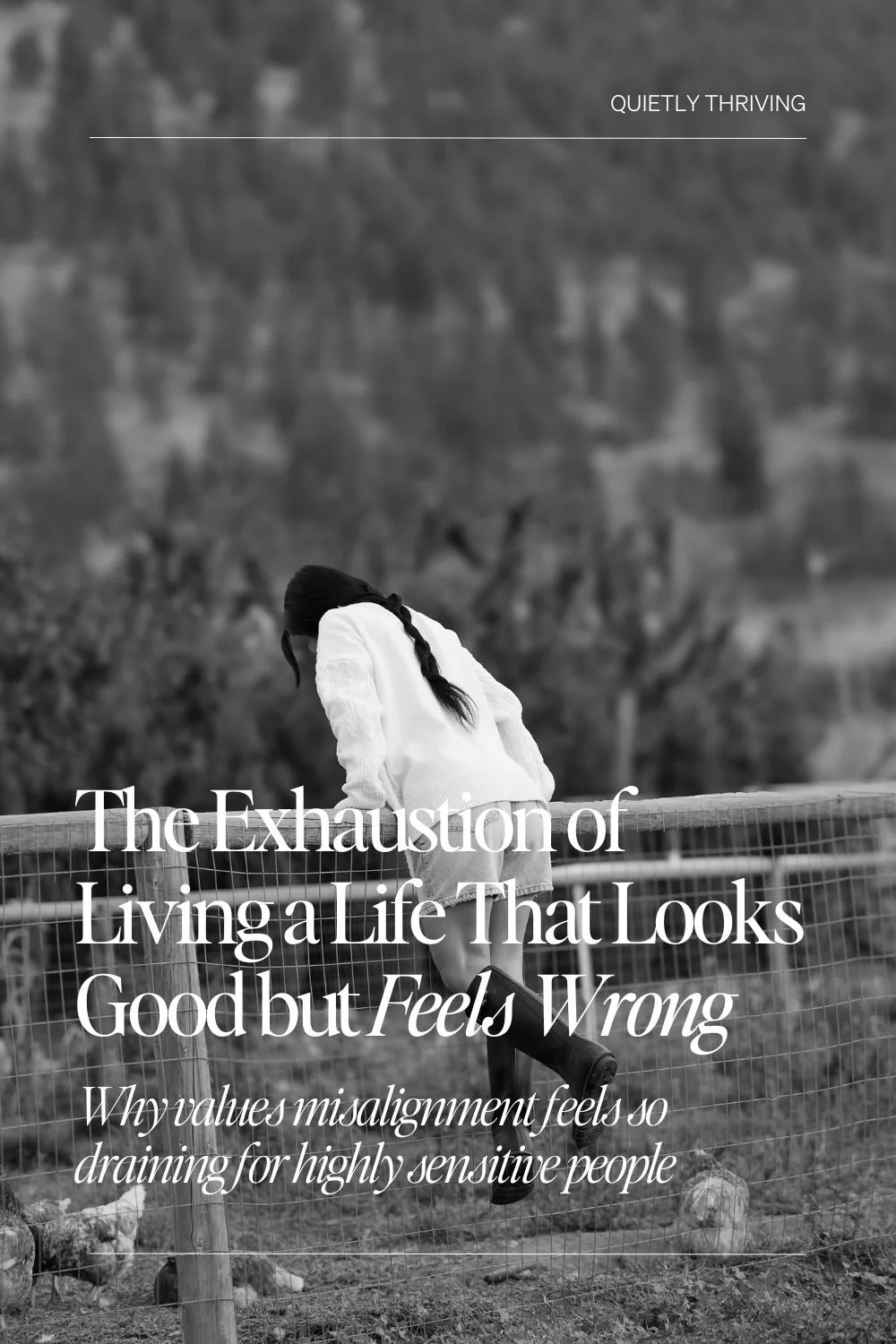
The Exhaustion of Living a Life That Looks Good but Feels Wrong
At a book swap recently, I picked upThe Top Five Regrets of the Dying, and the central theme felt painfully familiar: the regret of not living a life that is true to yourself.
Living out of alignment is exhausting, especially when it requires constantly adapting yourself to fit in, keep the peace and meet other peoples’ expectations.
For highly sensitive people, often exhaustion doesn’t come from doing too much - it comes from living too far away from what’s true.
You can have a life that looks stable, respectable, even successful - and still feel overwhelmingly tired, flat, or inherently drained.
You tell yourself you should be grateful. That nothing is “wrong enough” to justify how you feel.
Yet, your body tells a different story.
This kind of exhaustion isn’t laziness.
It isn’t a lack of resilience.
And it certainly isn’t failure.
It’s often the cost of values misalignment - living in ways that don’t reflect your inner truth, even if they make sense on paper.
When life looks fine but feels wrong
I spent years investing time and energy into designing a life that was completely wrong for me - but I learned quickly how to adapt and maintain a facade that everything was fine.
I became exceptionally skilled at people-pleasing; anticipating other people’s needs and choosing ‘sensible’ and ‘safe’ paths that I knew in my heart weren’t right.
Not because I didn’t know myself, but because my sensitivity meant I could feel when something was off long before I could name it.
It’s like, you’re functioning… but you’re no longer anchored to what’s true.
You’re coping… but you never feel at home in your own life.
And eventually, your body begins to speak.
Through fatigue.
Through overthinking, indecision and never quite fully trusting yourself.
Through a low-grade sense of unease that’s always present.
Values aren’t ideals - they’re anchors
When it comes to values, most people think about them as guiding principles or aspirations - things we should care about and uphold in our lives.
But for deep-feeling, highly sensitive people, values are something else entirely.
They’re not what sounds good.
They’re not what looks impressive.
They’re not what earns approval.
Values are what steadies our nervous systems.
They’re the environments, rhythms, relationships, and ways of working that allow our bodies to soften rather than brace.
They’re what reduces internal friction - not what increases pressure.
When your life aligns with your values, there’s a sense of rightness.
Not excitement. Not adrenaline.
Just a deeply rooted feeling of yes, this is right, like your inner and outer worlds finally match.
Anchoring: coming back to what’s true
I like to think of this phase as anchoring.
It’s the process of reconnecting with your truth - not by analysing or fixing yourself, but by listening.
It’s normal to arrive at this place feeling fragmented after years of sacrificing your needs and identity; completely unsure of what you actually want anymore.
Not because you’ve lost yourself.
But because you’ve been prioritising survival, harmony and functionality for a really long time.
Anchoring begins when we stop asking:
“What should I do with my life?”
and start asking:
What feels steady?
What feels off?
What am I overriding?
This is about restoring contact with your inner compass.
Why clarity can’t be forced
For highly sensitive people, clarity doesn’t emerge through pressure.
It emerges through safety.
When your nervous system has been living in a state of vigilance - monitoring, adjusting, holding things together - it doesn’t respond well to demands for answers.
That’s why trying to “figure it out” often leads to more confusion.
And why most values exercises can feel frustrating or abstract.
Before clarity, there’s a vital step: learning to be with yourself again.
Noticing how your body responds to different choices.
Recognising where you’re bracing versus where you’re settling.
Trusting that your exhaustion is information - not something to push through.
A gentle reflection
You don’t need to answer this now, just notice what comes up -
Where in your life are you functioning well, but feeling drained?
What parts of your day require constant effort to maintain?
What would it feel like to choose steadiness over appearance?
A supportive next step
When we begin reconnecting with what’s true, it can help to have something steady to return to - not to figure anything out, but to stay grounded as your awareness shifts.
I’ve created a Nervous System Companion Guide for Highly Sensitive People as a gentle, practical resource for moments like this, when you don’t need answers yet, just a safe place to land.
You can find it here.
Quietly thriving alongside you,
Rachel